

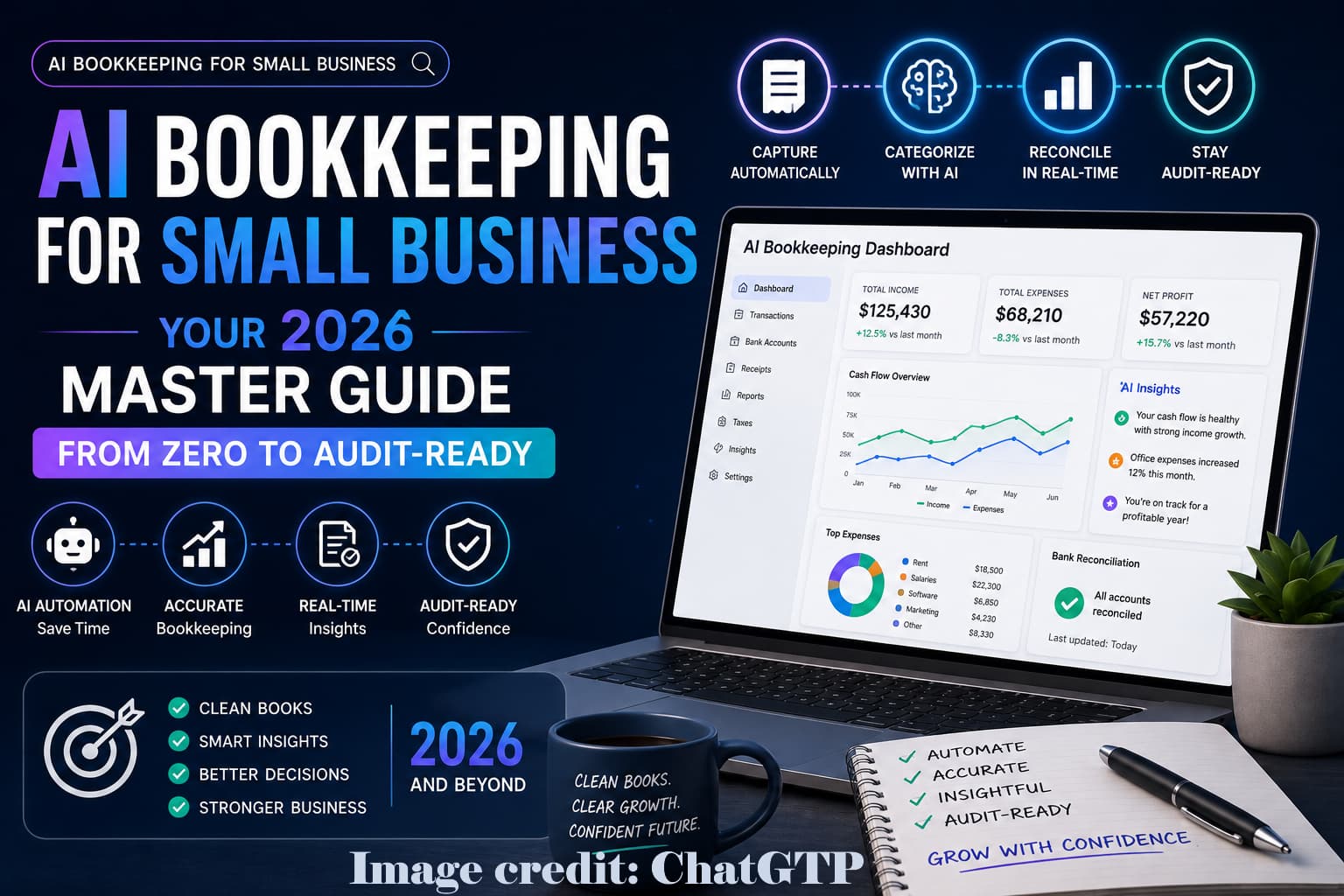
Introduction: The Ledger That Wouldn’t Balance
It was a Tuesday evening in September, and I was staring at a spreadsheet that had not been updated since March. Not because I forgot. Because I was afraid of what I would find.
I sat there hunched over spreadsheets at midnight, wondering where the month’s hard-earned cash actually went. I thought to myself: If this is what running a business feels like, why does it feel like I am stuck in a never-ending, high-stakes math test?
You are not alone. I have been there, invoices in one tab, bank statements in another, and a third tab open with a calculator that I kept getting wrong anyway. I have done the testing so you do not have to. What follows is my personal blueprint: plain English, no jargon, no fluff.
If you find bookkeeping taking too long, small business growth inevitably stalls out. If you are constantly worrying about whether your automated expense categorization is accurate, your focus splits. This master guide to AI bookkeeping for small businesses fixes both problems by replacing manual friction with automated workflows.
Moving your operations to an integrated system for AI bookkeeping for small businesses is not just about replacing manual typing with software clicks. It is a fundamental shift in your daily operations that transforms your bookkeeping from a stressful, backwards-looking chore at the end of the month into a real-time, forward-looking strategic asset that helps you make smart decisions every single day.
📈 The Reality Check
According to recent small business operational surveys, over 83% of successful small businesses have already integrated intelligent automation into their daily workflows, with financial management ranking as their highest-priority area for growth.
🧭 The Core Questions This Guide Answers
To build a financial setup that works seamlessly behind the scenes, we need to address the exact questions that small business owners, freelancers, and independent service providers face every day:
- How do I transition from messy spreadsheets to a secure, real-time platform?
- What does a complete, end-to-end automated financial stack look like in 2026?
- How do I use automation to stay completely audit-ready without losing human oversight?
- How do I connect my educational guides with specific software evaluations to make the right buying decisions?
🏗️ Why Your Current Finance System Is Costing You
Most small business owners and freelancers I speak with have the same setup: a mix of spreadsheets, a half-configured accounting app they signed up for once and never fully used, and a collection of receipts in a folder they will sort later. The cost of this is not just time, though it is that too.
A 2024 study by Intuit found that small business owners spend an average of 5 hours a week on financial administration. That is 260 hours a year. At even a modest billing rate of Rs 2,000 an hour, that is Rs 5,20,000 worth of your time going into tasks that AI can now handle in minutes.
But the real cost is the decisions you cannot make because your numbers are not clear. Have you ever said any of these to yourself?
- “I think we are doing okay, but I am not sure.”
- “I will check the cash flow situation at month end.”
- “I need to send that invoice but I keep forgetting.”
- “Tax time is coming and I am not ready.”
These are not organizational failures. They are system failures. And the fix is not to work harder: it is to build a system that works even when you are not looking at it.
Your Complete One-Week Setup Ritual: From Zero to Automated
Commit one week to building the foundation of your system. After that, maintenance takes less than 30 minutes a week.
Day-by-Day Setup Plan
- Day 1: Choose Your Tool. Based on the tool selection framework, pick one bookkeeping tool and sign up. Do not configure anything yet.
- Day 2: Connect Accounts. Link every business bank account and credit card. Enable auto-categorization and let it run.
- Day 3: Review and Teach. Look at the AI’s category suggestions for the past 30 days and correct the mistakes so it learns.
- Day 4: Set Up Invoicing. Create your invoice template and configure automated reminders for before, on, and after the due date.
- Day 5: Enable Forecasting. Turn on cash flow forecasting, set your view to 90 days, and note any surprising trends.
- Day 6: Set Your Alerts. Enable anomaly detection, set a minimum cash balance alert, and turn on payment confirmations.
- Day 7: Lock in the Habit. Set a weekly 15-minute reconciliation appointment and a monthly 30-minute review appointment in your calendar.
📊 Understanding the Four Layers: What Each Day Builds
The mistake most people make when adopting AI finance tools is picking a tool before they have identified their pain point. They sign up for everything at once, get overwhelmed, and abandon all of it.
Think of your financial system as four layers, each one building on the last. You do not move to the next layer until the previous one is running smoothly. Do not skip layers: a beautiful cash flow dashboard built on messy, uncategorized bookkeeping is just prettier chaos.
The Operational Architecture of The Four-Layer AI Finance System
| Layer | What It Solves | When to Add It |
| 1. Bookkeeping Automation | The daily chaos: receipts, categorization, reconciliation | Week 1. Start here always. |
| 2. Cash Flow Control | The anxiety: not knowing if you can afford things | Week 2, once bookkeeping is running. |
| 3. Tax Preparation | The annual dread: scrambling for documents at filing time | Month 2, once cash flow is clear. |
| 4. Audit Readiness | The risk layer: protecting what you have built | Month 3, as your business grows. |
Layer 1: How to Clean and Automate Your Books with AI Bookkeeping for Small Business
What Clean Books Actually Means
This layer is your foundation, and everything else depends on clean, consistently updated books. Clean books means every transaction is categorized correctly, every bank account is reconciled, and your profit and loss statement at any given moment reflects reality, not your best guess.
When planning out how to transition, learning the system layers to set up AI bookkeeping for small businesses to prevent future accounting errors.
Your Setup Checklist for Layer 1
- Connect all business bank accounts and credit cards to your bookkeeping tool with zero manual imports.
- Turn on auto-categorization and let the AI run for one week before you review anything.
- Review the AI suggestions category by category, correcting what is wrong so the tool learns.
- Enable bank feed alerts for any transaction over a specific threshold you choose.
The 15-Minute Weekly Ritual
Every week, on the same day, you open your bookkeeping tool and execute four mechanical checks:
- Review any transactions the AI flagged as uncertain to approve or correct them.
- Check the reconciliation screen, where green means matched and red means something needs attention.
- Look at the week’s expenses at a category level to spot anything wrong or surprising.
- Note anything unusual to discuss with your accountant at your next monthly check-in.
The AI does 95% of the work before you even sit down. Just pick a recurring time, like Monday morning while your chai brews or Friday afternoon before closing your laptop, and protect it.
Layer 2: Bookkeeping Automation for Freelancers and Cash Flow Control
Once your books are clean, you have data you can trust, which makes cash flow tracking for small businesses AI features incredibly accurate and useful. Bookkeeping automation for freelancers and small business owners eliminates structural anxiety gaps. When you cannot see what is coming and going, you spend mental energy managing uncertainty instead of managing your business growth.
The Three Cash Flow Problems AI Solves
- Problem 1: Uncertain Inbound Timelines. Clients say 30 days but pay in 47. AI invoicing tools track payment patterns per client and nudge them at exactly the right moment based on their history. Set up an automated bookkeeping workflow loop for small businesses that sends reminders with escalating urgency across four points (friendly, polite, direct, and firm) to avoid composing a single awkward email.
- Problem 2: Hidden Shortfalls. Cash flow forecasting tools look at confirmed invoices, upcoming bills, and historical patterns to map your bank balance across 30, 60, and 90 days. Seeing a shortfall six weeks out gives you options to chase payments early or delay purchases. Seeing it six days out means panic.
- Problem 3: Slipping Vendor Payments. Missed vendor payments damage supplier relationships and trigger late fees. AI-powered accounts payable tools let you schedule all vendor payments in advance so money leaves your account on the right day automatically.
Your Setup Checklist for Layer 2
- Configure invoice reminders with at least three escalating touchpoints before, on, and after due dates.
- Enable cash flow forecasting in your bookkeeping tool and set your view to 90 days.
- Tag your top five clients by payment reliability and adjust reminder timing accordingly.
- Schedule all recurring vendor payments in advance and review the list monthly.
- Set a minimum cash balance alert to be notified immediately when your balance drops below a safe threshold.
Layer 3: Tax Preparation, Compliance, and AI Accounting for Small Business Owners
The reason tax time feels like a crisis is that twelve months of financial chaos arrive compressed into a few weeks. When you establish automated AI bookkeeping for small business, tax season becomes a non-event. Executing smart AI accounting workflows and setting up custom automation rules for small business owners ensures your documents are organized, validated, and ready before you even ask for them.
| Tax Task | How AI Handles It |
| Expense Categorization | Auto-tags deductible categories all year round with no year-end scramble. |
| GST/VAT Tracking | Flags GST on every transaction and generates returns data automatically. |
| Receipt Matching | Matches every digital receipt to the correct transaction to eliminate the shoebox. |
| Deduction Identification | Flags commonly missed deductions like home office, travel, and software. |
| Audit Trail Logs | Creates a timestamped record with receipts attached and categories confirmed. |
| Expert Collaboration | Exports clean reports in the exact format your accountant needs in one click. |
The Year-Round Tax Habit
Stop thinking about tax as a seasonal activity. Every month, review your expense categories to reclassify personal versus business items. Every quarter, run a profit and loss statement to know your approximate tax liability before your CA tells you. At year-end, your books should be 95% ready for a faster, cheaper engagement.
Layer 4: Fraud Detection and How to Get Audit-Ready Small Business Frameworks
This layer is about protection, not paranoia. Organizations lose roughly 5% of annual revenue to fraud, and small businesses are hit hardest because they typically lack internal controls. Learning how to get audit ready small business records dynamically saves you from massive regulatory stress.
The Three Elements That Protect You
- Anomaly Detection: Modern bookkeeping tools have built-in anomaly detection to flag transactions that do not match your normal patterns, unexpected payments, or duplicate invoices. Enable email or push alerts for anomalies and review them as they arrive.
- Access Controls: If anyone else has access to your financial systems, set explicit, limited user permissions so they see only what they need and nothing more. Run a permissions audit today to verify who can access your tools.
- Audit Readiness as a Habit: Once a month, open your books and ask yourself a simple question: if a tax authority requested documentation for any transaction this month, could I provide a small business bookkeeping audit ready 2026 digital trail within one hour? If yes, you are audit-ready. If no, identify what is missing and fix it before the month ends.
⚖️ The Balance: Human Oversight vs. Machine Automation
As a structural editor who loves small details, I must emphasize a critical rule for 2026: automation does not mean abdication. AI is an incredibly powerful co-pilot, but it should never be left to fly the plane entirely alone.
AI is phenomenal at executing repetitive daily tasks like matching invoices, scanning expenses, and organizing line items. However, it lacks the ability to understand complex, country-specific tax laws, nuanced corporate structures, or long-term personal wealth strategies. Use AI to handle 95% of your daily administrative work, and use the time and money you save to hire a certified accountant or professional tax advisor for high-level strategy and annual filings.
🔬 Barnali’s Perspective: The Human Testing Grounds
The first time I properly set up a workflow for AI bookkeeping for small businesses, I did not feel proud. I felt embarrassed that I had waited so long.
The Duplicate Payment That Paid for Everything
Within the first week, the system flagged a duplicate payment I had been making to a software subscription for four months. That was Rs 11,200 I got back: the tool paid for itself before I had even finished setting it up.
The End of Finance Sunday
I used to spend a Sunday every month, four to five hours, catching up on books I had let slide. I called it “finance Sunday” and I dreaded it all week. When I switched to the 15-minute weekly ritual, the Sunday sessions disappeared entirely. Turns out, five minutes four times a month is infinitely easier than 240 minutes once a month.
The Cash Flow Near-Miss
The moment that converted me to AI cash flow forecasting was a near-miss in October 2024. Xero flagged that if my two largest clients both paid on their usual schedule, I would be Rs 38,000 short the week a major software renewal was due. I moved the software renewal by three weeks, chased one invoice early, and the crisis never actually arrived.
The GST Crisis That Became a Non-Event
I even cried over GST returns in 2023: actual frustrated tears at 11 PM in November because four months of chaos needed to be untangled the night before a deadline. Now, Zoho Books handles my GST categorization in real time. My CA’s bill went down by 30% because I stopped handing her a mess.
When a colleague had a vendor impersonation incident where a fake invoice cost them Rs 45,000, I turned on anomaly detection that same afternoon. It has flagged three suspicious transactions since: none were fraud, but one was an Rs 8,400 billing error that would have slipped through. This layer costs almost nothing to set up once your other layers are running. There is zero reason not to have it.
🔗 Connected Intelligence: Choosing Your Layer 1 Stack for AI bookkeeping for small businesses
The right software choice depends entirely on your specific business size and where your operations are based:
| Your Situation | Best Starting Point | Why |
| Freelancer, under Rs 41L revenue, Indian market | Zoho Books (free tier) | GST-ready out of the box with native connections for HDFC, ICICI, and SBI. |
| Freelancer or solopreneur, global clients | Wave (free) | Handles multi-currency seamlessly with no monthly cost and receipt scanning included. |
| Small business, 2 to 10 team members | QuickBooks Online or Zoho Books Standard | Provides multi-user access, stronger automation engines, and payroll integration options. |
| Growing business, finance team involved | Xero | Best-in-class accountant collaboration frameworks with highly flexible reporting extensions. |
Looking for deep, hands-on software reviews, accurate user-interface breakdowns, and verified pricing analysis for standalone financial tools? Check out our dedicated review hub over at AIAppDomain.com.
If you want to jump straight into our raw, unfiltered tool breakdowns, read our comprehensive evaluation of AI Bookkeeping Tools for Automation: Top Tools for Accountants to see exactly how these applications performed under our strict testing metrics. For a bird’s-eye view of how to tie these tools into your structural operations, explore our master operational hub in The 2026 Master Guide to AI Finance and Bookkeeping: From Automation to Audit-Proofing.
💬 Frequently Asked Questions on AI bookkeeping for small businesses
I am not a numbers person. Is this system too complicated for me?
Not at all, as the system is built on the premise that you should not have to be a numbers person. The AI handles the heavy lifting of categorization, reconciliation, and proactive alerts. Your only job is to look at what it shows you to confirm or correct it: if you can check your email, you can run this system.
Do I need a separate tool for each layer, or can one tool do everything?
Most modern bookkeeping tools cover Layers 1 and 2, and partially Layer 3. Centralized platforms handle bookkeeping, invoicing, cash flow, and basic tax reporting in one interface. For example, you can analyze QuickBooks vs Zoho Books small business features on our directory site to see how they manage all-in-one data layers. For Layer 4, your bookkeeping tool’s built-in anomaly alerts handle 80% of what a small business needs.
Is an AI bookkeeping system freelancer in India compliant?
Yes, platforms like Zoho Books’ free tier for small businesses offer complete GST-ready structuring for Indian operations out of the box. If you run a global operation, pairing this framework with automated bookkeeping workflow tools can optimize the best bookkeeping software for freelancers in India parameters for cross-border conversions.
How much does building this system actually cost?
Layer 1 can be completely free using Wave or the Zoho Books free tier. Layers 2 and 3 typically cost between Rs 1,200 and Rs 3,500 a month depending on your tool and plan, while Layer 4’s core features are included in most paid plans. The full system costs less than a single hour of accountant time per month and reduces your accountant’s billing hours significantly.
My bookkeeper already handles all of this. Why do I need an AI system?
Your bookkeeper handles it at month end, at minimum, whereas AI handles it in real time. The value is not in replacing human professionals but in giving them cleaner data to work with while giving you real-time visibility between those monthly catch-ups. Many bookkeepers welcome clients who arrive with AI-organized data because it means faster, more focused strategic sessions.
What if I have been neglecting my books and they are currently a mess?
Start from today, not from the beginning. Connect your accounts, let the AI categorize your recent transactions, and work forward. For anything older than three months that remains a total mess, flag it for your accountant. The cost of cleaning up old books is almost always lower than the cost of anxiety about not having done it yet.
The Community Ledger Closer
Choosing your primary accounting software is an important step toward reclaiming your creative time and building a genuinely scalable business system. Every tool we cover excels at a specific workflow, so focus on the platform that aligns closest with your immediate operational needs.
Let us keep this conversation going in a real, human way. Which software platform are you currently using to manage your business books, and what specific part of your financial tracking still feels like a midnight math test?
Drop your thoughts in the comment section below, or send me a direct note through our platform network. I read every single message, and your real-world experience might provide the exact clarity another business owner needs to work smarter.
Pick your Layer 1 tool right now before you close this tab using our framework table. Sign up for a free trial or free tier without configuring anything yet just to have the account ready. Come back tomorrow and connect your first bank account. The system does not get built all at once: it gets built one layer at a time, one week at a time, one small decision at a time.
With chai-fueled clarity and a spreadsheet-free Sunday,
Barnali (Founder & Content Creator, AllBasicKnowHow.com)
⚠️ Legal Disclaimer
This guide on AI bookkeeping for small businesses is for general information and educational purposes only. It is not financial, legal, or tax advice. Every business is different; please consult a licensed accountant or financial advisor before making significant decisions about your financial systems. Pricing and features mentioned reflect publicly available information at the time of writing and may have changed. Always check the official tool website for current plans. Some links in this guide may be affiliate links through which we earn a small commission at no extra cost to you. We only recommend tools we have used and trust.
